
When homeowners need gutter installation, repair, cleaning, gutter guards, or replacement, Google is often where they look first.
Gutter SEO helps your business appear for those searches in both Google Maps and the organic results, then turn that visibility into calls, estimate requests, and booked jobs.

This guide covers the full gutter SEO process, including how to:
- target searches most likely to generate leads
- build the right service and location pages
- improve visibility in Google Maps and organic search
- strengthen authority with reviews, citations, and backlinks
- publish content that supports commercial services
- track SEO through leads, estimates, jobs, and revenue
Use the table of contents below to jump to the areas that matter most for your business.
Table of Contents
- What Is SEO for Gutter Contractors?
- How People Search for Gutter Companies
- The Ideal Website Structure for a Gutter Company
- How to Optimize a Gutter Service Page for Google
- Google Business Profile SEO for Gutter Contractors
- How Gutter Companies Can Earn More Reviews
- Citations and Business Listings for Gutter Companies
- Link Building for Gutter Contractors
- Content Marketing for Gutter Companies
- Technical SEO for Gutter Contractor Websites
- Turn SEO Traffic Into Gutter Leads
- How to Measure Gutter SEO Results
- SEO and AI Search for Gutter Contractors
- How Much Does Gutter SEO Cost?
- How Long Does SEO Take for a Gutter Company?
- A 90-Day Gutter SEO Plan
- Gutter Contractor SEO Checklist
- Frequently Asked Questions About Gutter SEO
What Is SEO for Gutter Contractors?
SEO for gutter contractors is the process of improving a gutter company's visibility when potential customers search Google for the services it provides.
The goal is not traffic for its own sake. It is to appear in front of homeowners, businesses, and property managers who may need gutter installation, replacement, repair, cleaning, protection, or drainage work.
For most gutter companies, that means competing in two places: Google Maps and Google's traditional organic search results.
What Does Gutter SEO Actually Help You Rank For?
Gutter SEO can target searches at several stages of the buying process.
Someone searching “gutter contractor near me” is looking for a company. Someone searching “gutter repair” probably already knows what service they need. Someone searching “seamless gutters” may still be comparing systems before choosing a contractor.
Common commercial searches include:
- gutter contractor near me
- gutter company near me
- gutter installation
- gutter replacement
- gutter repair
- seamless gutters
- gutter guards
- gutter cleaning
- downspout installation
- commercial gutters
Location can also be built directly into the query:
- gutter installation Des Moines
- gutter repair Cedar Rapids
- gutter company Denver
- seamless gutters Minneapolis
These searches should not automatically lead to the same page. A strong website matches important search intents with the page best equipped to satisfy them.
Google Maps vs. Organic Search Results
Gutter contractors are usually competing for two different types of Google visibility.
Google Maps and the local pack surface local businesses and Business Profiles.
Organic results surface webpages such as homepages, service pages, location pages, guides, directories, and project pages.
A contractor can perform well in one and poorly in the other.
Google says local results are primarily based on relevance, distance, and prominence/popularity. Organic Search uses a much broader set of systems to determine which webpages should appear.
A complete gutter SEO strategy needs to work on both.
How People Search for Gutter Companies
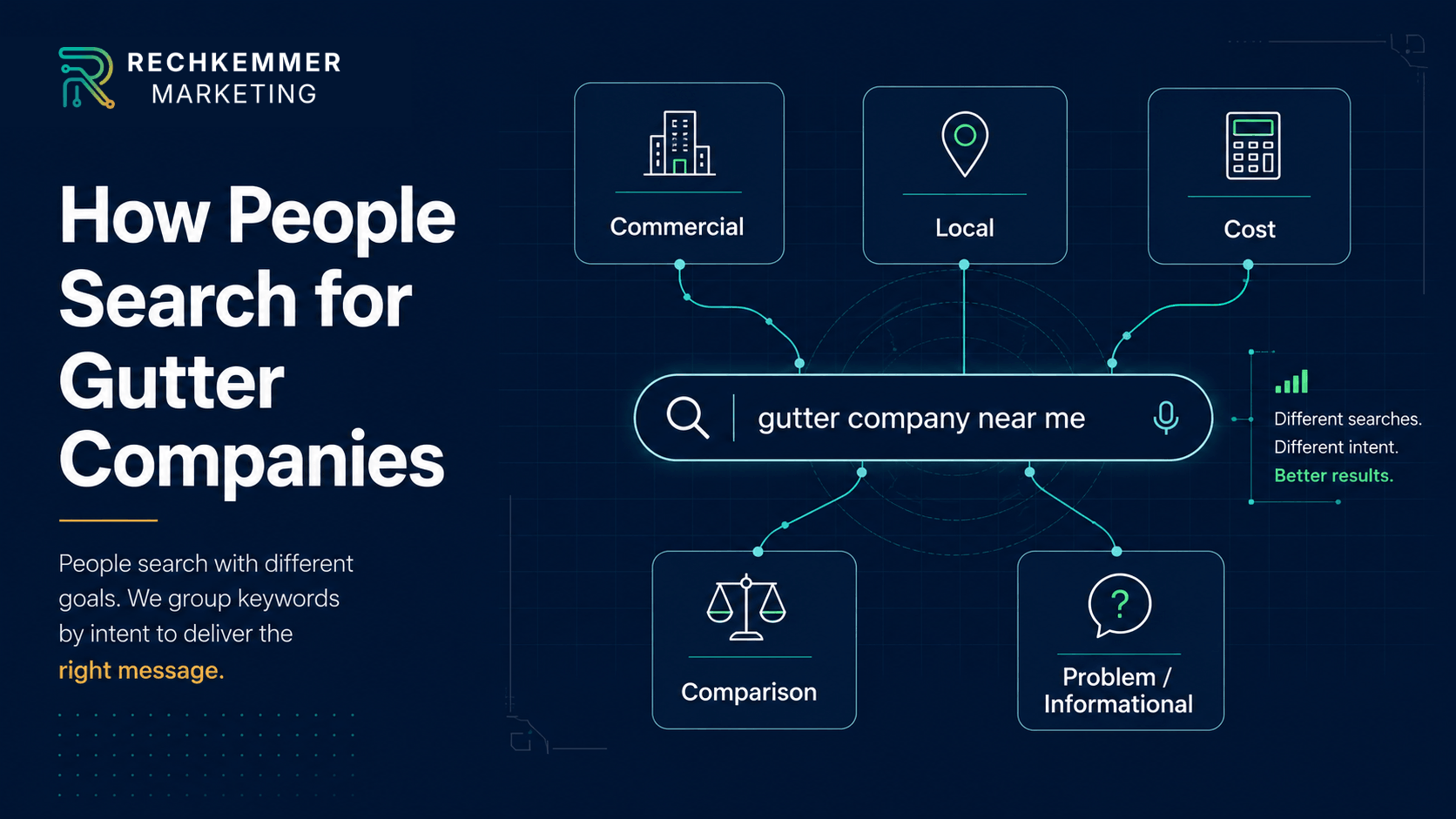
Not every gutter keyword represents the same customer.
A homeowner looking for a contractor to install new gutters has different intent from someone researching whether 5-inch or 6-inch gutters are better. Understanding that distinction is what turns keyword research into a useful website.
The Main Types of Gutter Keywords
Most gutter searches can be grouped into a handful of categories.
| Keyword type | Examples | Likely destination |
|---|---|---|
| Contractor/company | gutter contractor, gutter company near me | Homepage or main service page |
| Installation | gutter installation, gutter installers | Installation page |
| Replacement | gutter replacement | Replacement page |
| Repair | gutter repair, leaking gutter repair | Repair page |
| Cleaning | gutter cleaning service | Cleaning page |
| Gutter guards | gutter guard installation | Gutter Guards page |
| Material | copper gutters, aluminum gutters | Material/service page |
| Style | half-round gutters, K-style gutters | Style/service page |
| Size | 6-inch gutters, 7-inch gutters | Size page or supporting content |
| Commercial | commercial gutter installation | Commercial page |
| Problems | gutters overflowing, sagging gutters | Guide or repair page |
| Cost | gutter installation cost | Cost guide |
| Comparison | 5-inch vs. 6-inch gutters | Comparison guide |
| Informational | how long do gutters last | Article/resource |
| Local | gutter repair Cedar Rapids | Service/location page |
These categories frequently overlap.
“Copper gutter installation near me” contains product, installation, local, and commercial intent in a single query.
The job of keyword research is not to assign every phrase to a perfect category. It is to determine what the searcher expects to find.
Commercial Intent vs. Informational Intent
Consider:
gutter installer near me
versus:
how often should gutters be cleaned
Both concern gutters. Only one clearly indicates someone looking to hire a contractor right now.
The first query belongs on a commercial page built to generate an estimate.
The second belongs on an informational page that answers the question and, where appropriate, links to a gutter cleaning service.
Commercial pages should focus on:
- the service
- who needs it
- products or systems offered
- problems solved
- process
- service area
- proof
- next step
Informational pages should answer the question first.
How to Map Gutter Keywords to Pages
The rule is simple:
Don't create one page for every keyword. Create one page for every meaningfully different search intent.
These phrases can probably target the same installation page:
- gutter installation
- gutter installers
- gutter installation company
- professional gutter installation
- gutter installation near me
Creating five nearly identical pages would add little value.
But gutter installation and gutter repair represent different customer needs and usually justify separate commercial content.
A simplified keyword map could look like this:
| Keyword cluster | Recommended page |
| gutter company / gutter contractor | Homepage |
| gutter installation / gutter installers | Gutter Installation |
| seamless gutter installation | Seamless Gutters |
| gutter replacement | Gutter Replacement |
| gutter repair | Gutter Repair |
| gutter cleaning | Gutter Cleaning |
| gutter guards | Gutter Guards |
| commercial gutter systems | Commercial Gutters |
| copper gutters | Copper Gutters, if offered |
| 5-inch vs. 6-inch gutters | Comparison guide |
| gutter installation cost | Cost guide |
| gutter installation + city | Relevant local landing page |
Ask one question whenever you find a new cluster:
Would someone searching this expect meaningfully different information from the page we already have?
If the answer is no, combine the keywords.
The Ideal Website Structure for a Gutter Company
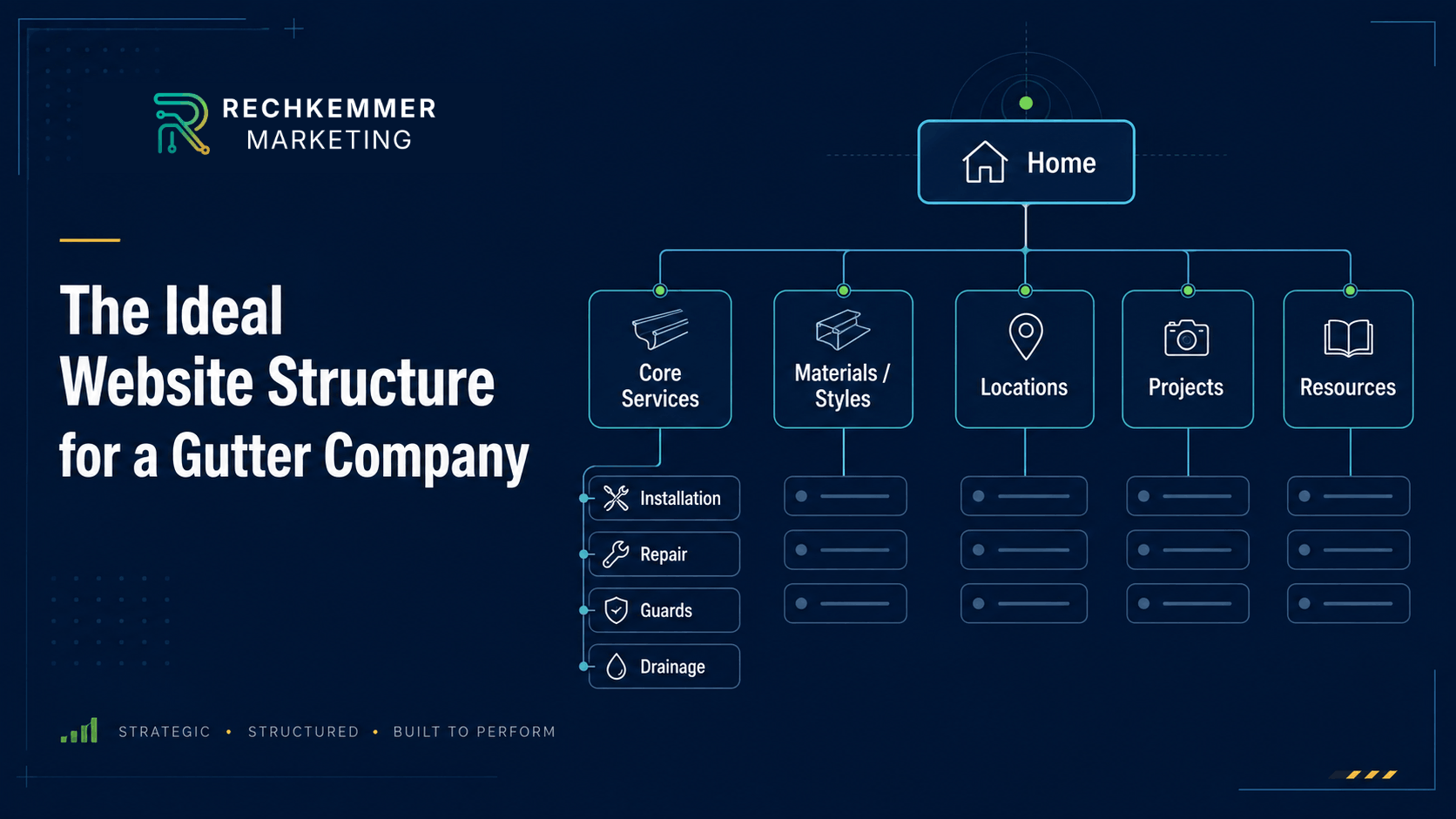
A gutter website should be organized around what the company actually sells and what customers actually search for.
To understand what that looks like in practice, we reviewed 36 gutter contractor websites across 12 U.S. markets and coded 15 different page and content types.
This was an architecture study, not a ranking-factor study. The contractors were selected because they had substantial gutter-specific websites; the data does not prove that creating any specific page causes higher rankings.
It does show which topics repeatedly appear on mature gutter websites.
| Page/content type | Observed |
| Gutter Installation | 36 / 36 |
| Seamless Gutters | 36 / 36 |
| Gutter Guards | 35 / 36 |
| Drainage / Downspouts | 33 / 36 |
| Materials / Styles | 32 / 36 |
| Gutter Repair | 31 / 36 |
| Gutter Replacement | 28 / 36 |
| Gutter Cleaning | 27 / 36 |
| Blog / Resources | 26 / 36 |
| Location Pages | 25 / 36 |
| Commercial Gutters | 23 / 36 |
| Gutter Sizes | 19 / 36 |
| Soffit / Fascia | 18 / 36 |
| Projects / Portfolio | 14 / 36 |
| Cost / Comparison Content | 8 / 36 |
The strongest takeaway is that a mature gutter website usually needs more depth than:
Home → About → Services → Contact
A possible structure is:
Home
- Gutter Services
- Gutter Installation
- Seamless Gutters
- Gutter Replacement
- Gutter Repair
- Gutter Cleaning
- Gutter Guards
- Downspouts / Drainage
- Gutter Types & Materials
- Aluminum Gutters
- Copper Gutters
- Half-Round Gutters
- K-Style Gutters
- Other systems actually offered
- Commercial Gutters
- Locations
- City A
- City B
- City C
- Projects
- Resources
- Cost Guides
- Comparisons
- Maintenance
- Gutter Problems
That is a framework, not a required sitemap.
The Core Gutter Service Pages
For a full-service gutter contractor, the commercial architecture should usually start with the services that actually generate revenue.
Our sample suggests evaluating these first:
- Gutter Installation
- Seamless Gutters
- Gutter Replacement
- Gutter Repair
- Gutter Cleaning
- Gutter Guards
- Downspouts / Drainage
Installation and seamless gutter content appeared across the entire 36-site sample. Gutter guards appeared on 35 sites, downspout/drainage content on 33, and repair on 31.
That makes them strong candidates for core architecture when the company offers those services.
But frequency does not override reality.
If your company does not provide gutter cleaning, don't create a cleaning page simply because competitors do.
Gutter Material and Style Pages
Product selection creates another layer of search demand.
Materials or gutter styles appeared on 32 of 36 websites in our sample.
Examples included:
- aluminum gutters
- copper gutters
- steel gutters
- galvanized gutters
- half-round gutters
- K-style gutters
- box gutters
- fascia-style systems
- custom gutter systems
Not every product needs a page.
A contractor that actively sells premium copper systems may have enough to say about copper gutters—the appearance, price, installation, lifespan, patina, compatible architecture, and completed projects—to justify a dedicated commercial page.
A material offered once every few years may belong on a broader Gutter Materials page instead.
Use three tests:
- Do we actually sell this?
- Is there meaningful search demand?
- Does the SERP show that users expect a distinct page?
Build the page when all three support it.
Should You Create 5-Inch, 6-Inch and 7-Inch Gutter Pages?
Size-specific gutter content appeared on 19 of the 36 websites we reviewed.
That does not mean every contractor needs three URLs.
You have several options.
Option 1: Individual product pages
/5-inch-gutters/ /6-inch-gutters/ /7-inch-gutters/This makes sense when the company actively sells each system and the search results support separate commercial pages.
Option 2: One Gutter Sizes page
Use one page to explain the available sizes, applications, roof-water capacity considerations, and selection process.
Option 3: Comparison content
Publish:
5-Inch vs. 6-Inch Gutters: Which Size Does Your Home Need?
Then link that guide to the main gutter installation page.
Let search intent determine the format.
Additional Gutter Services
Our research also found gutter companies expanding into:
- fascia
- soffit
- underground drainage
- French drains
- rain chains
- snow guards
- ice-related services
- scuppers
- commercial roof drainage
These are conditional pages, not universal requirements.
Climate matters.
Cold-weather contractors in markets such as Minnesota and Colorado showed more snow- and ice-related services. Seattle-area sites placed heavier emphasis on drainage and wet-climate problems. Phoenix competitors introduced scuppers and commercial roof drainage. Florida competitors showed more emphasis on larger systems and heavy-rain applications.
The correct architecture is therefore:
Core gutter services + actual adjacent services + market-specific opportunities
not:
Copy the biggest competitor's sitemap.
Commercial Gutter Service Pages
Dedicated commercial gutter content appeared on 23 of 36 sites in our sample.
Create a commercial section when commercial work is something the company actively wants.
A strong page might cover:
- commercial gutter installation
- commercial gutter replacement
- commercial gutter repair
- box gutters
- oversized systems
- commercial downspouts
- roof drainage
- building types served
- maintenance capabilities
- past commercial projects
A property manager responsible for an apartment complex has different questions from a homeowner replacing gutters on a single-family home. Your pages should reflect that difference.
Location Pages for Gutter Contractors
Location pages appeared on 25 of 36 sites in our sample.
A basic structure might look like:
/locations/ /locations/cedar-rapids/ /locations/iowa-city/ /locations/waterloo/The goal is not to publish a page for every town within driving distance.
Create location pages for markets you actively serve and want to grow in.
Useful location pages can include:
- services available in that city
- completed local projects
- original project photos
- locally relevant reviews
- neighborhoods or nearby communities served
- weather or drainage issues that genuinely affect the market
- links to relevant service pages
- a local estimate CTA
Avoid pages where only the city name changes.
Google's spam policies specifically warn against scaled, low-value pages and keyword-heavy blocks of cities created primarily to manipulate rankings.
Should You Create Service-by-City Pages?
Some contractors go further:
/cedar-rapids/gutter-installation/ /cedar-rapids/gutter-repair/ /cedar-rapids/gutter-guards/This can work when individual service + city combinations have enough demand and the company has enough local evidence to create useful pages.
It should not be automatic.
Ten services across 20 cities creates 200 potential pages.
If those 200 pages are mostly the same copy with different city names, you have created scale without value.
Start with the strongest services and highest-priority markets. Expand only where the search opportunity and available content justify it.
Local Project Pages
Project pages are one of the strongest opportunities we found because contractors already create the raw material every time they complete a job.
Instead of putting every photo into one gallery, document selected projects:
/projects/cedar-rapids-6-inch-seamless-gutter-installation/The page can include:
- location
- customer problem
- service performed
- gutter system
- gutter size
- material or color
- drainage considerations
- before-and-after photos
- project outcome
A single project page can support several areas of the site:
Cedar Rapids 6-Inch Seamless Gutter Project
- Cedar Rapids Location
- Gutter Installation
- Seamless Gutters
- 6-Inch Gutters
Project pages provide something generic SEO copy cannot: first-party evidence of real work.
Projects or portfolios appeared on only 14 of 36 sites in our initial sample, which also means there is room to differentiate.
Don't document every job. Prioritize projects that add something useful: a different city, premium material, unusual drainage problem, commercial application, gutter size, gutter guard system, or strong before-and-after result.
How to Optimize a Gutter Service Page for Google
Once you know which pages should exist, optimize each one around a clear service and customer need.
Google's own Search Essentials recommend using the words people search for in prominent locations such as titles and headings while creating useful, people-first content.
What Should Be Included on a Gutter Service Page?
A useful gutter service page will often include:
- A clear H1
- A direct explanation of the service
- Problems the service solves
- Systems, sizes, or materials available
- Installation or service process
- Original project photos
- Reviews or proof
- Service area
- Pricing factors where appropriate
- Common questions
- Related services
- A clear call to action
You do not need all 12 sections on every page.
The page needs enough information for someone to understand the service, determine whether the company can solve their problem, and take the next step.
Titles, Headings and Keyword Placement
Write for clarity first.
A gutter repair page does not need a title like:
Best Affordable Professional Local Gutter Repair Company Near Me in Cedar Rapids Iowa
A cleaner structure would be:
Title: Gutter Repair in Cedar Rapids, IA | Company Name
H1: Gutter Repair in Cedar Rapids
Then use natural supporting headings:
- Common Gutter Problems We Repair
- Seamless Gutter Repair
- Downspout Repair
- When to Repair vs. Replace Your Gutters
- Request a Gutter Repair Estimate
Google explicitly recommends descriptive language in titles, headings, link text, and other prominent areas while warning against keyword stuffing.
Use Real Gutter Project Photos
Original photos do three jobs.
They show customers the quality of your work.
They provide unique page content.
They can also support image search when placed in relevant context and described properly.
Useful photos might include:
- before-and-after systems
- gutter corners and miters
- downspout routing
- gutter guard installation
- copper systems
- oversized systems
- commercial drainage
- fascia repair
- completed elevations
Stock photos are better than no visuals, but they do not provide the same proof.
Internal Linking for Gutter Contractors
Internal links connect related pages and help both visitors and search engines understand the site's structure.
Google recommends descriptive, contextual anchor text and says pages you care about should have links from other pages on your site.
A gutter installation page might link to:
- Seamless Gutters
- 6-Inch Gutters
- Copper Gutters
- Gutter Installation Cost
- relevant city pages
- relevant project pages
Supporting content should also link back.
For example:
5-Inch vs. 6-Inch Gutters
→ Gutter Installation
and:
Copper Gutter Cost
→ Copper Gutters
Internal links should follow the customer's next logical question. Don't force exact-match anchor text into every paragraph.
Image SEO for Gutter Contractors
Google recommends placing images near relevant text and using descriptive filenames and alt text.
Instead of:
IMG_4832.jpguse:
6-inch-seamless-gutter-installation-cedar-rapids.jpgwhen that accurately describes the image.
Alt text should describe what is visible:
6-inch white seamless gutter installed on two-story home
Don't stuff it with every nearby city and keyword.
Also compress large project photos before uploading them. A contractor website full of multi-megabyte phone photos can become unnecessarily slow.
Google Business Profile SEO for Gutter Contractors
For local gutter searches, your Google Business Profile can be as important as your website.
Google says local rankings are mainly determined by relevance, distance, and prominence/popularity. It also says complete and accurate business information, reviews, photos, and web prominence can contribute to local visibility.
Choose the Right Business Categories
Choose the primary category that most accurately describes what the business is, not every service it happens to offer.
Google recommends selecting the most specific primary category available and using only a few additional categories necessary to describe the business.
Categories change over time, so inspect the choices available in your actual Business Profile rather than relying on an old blog post.
Do not add unrelated categories simply because a competitor uses them.
Add the Gutter Services You Actually Offer
Google allows eligible service businesses to add suggested or custom services to their profiles.
A gutter company could organize its profile around real offerings such as:
- gutter installation
- gutter repair
- gutter replacement
- seamless gutters
- gutter cleaning
- gutter guards
- downspout work
Only add services you actually provide.
Keep the website and profile consistent enough that someone moving between the two gets the same understanding of the business.
Set Accurate Service Areas
Many gutter companies operate as service-area businesses.
Google currently allows up to 20 service areas and says the overall area generally should not extend more than roughly two hours of driving time from where the business is based.
Adding 20 distant cities does not make you rank in 20 cities.
Service areas describe where the business operates. They do not override Google's distance component.
Use them accurately.
Use Project Photos
Your Business Profile gives completed gutter jobs another useful destination.
Upload photos showing:
- completed gutter systems
- before-and-after work
- downspout routing
- guard installations
- different materials
- commercial projects
- crews and branded vehicles where appropriate
Use the same project documentation system that feeds your website.
One job can provide photos for the Business Profile, service pages, project pages, social media, and sales follow-up.
Keep the Profile Accurate
Check regularly for:
- business hours
- phone number
- website
- category changes
- services
- address or service area
- duplicate profiles
- user-suggested edits
Google's guidelines require businesses to represent themselves consistently as they exist in the real world and prohibit adding unnecessary service or location keywords to the business name.
If your real company name is ABC Gutters, don't rename the profile:
ABC Gutters | Seamless Gutter Installation & Repair Cedar Rapids
unless that is genuinely how the business is represented in the real world.
How Gutter Companies Can Earn More Reviews
Ask real customers for honest reviews after completed work.
Google allows businesses to request reviews, including through a review link or QR code, but prohibits incentives and attempts to manipulate what the customer writes.
When to Ask
The best time is usually when the customer has just experienced a successful outcome:
- project walkthrough completed
- repair confirmed
- invoice paid
- customer compliments the crew
- follow-up confirms everything is working
Make review requests part of the operating process instead of relying on employees to remember.
Keep the Request Simple
For example:
Thanks again for choosing us. If you have a minute, we'd appreciate an honest Google review about your experience.
Then provide the direct review link.
Do not offer a discount, gift, or prize in exchange for the review. Google considers incentivized reviews fake engagement.
Also avoid telling customers what keywords, employee names, locations, or services they should mention. Google's policy specifically says merchants should not request that particular content be included in reviews.
Respond to Reviews
Respond to both positive and negative reviews professionally.
For positive reviews, thank the customer without stuffing the response with search terms.
For negative reviews, address the issue rather than arguing publicly.
Reviews are customer-facing proof first.
Citations and Business Listings for Gutter Companies
A citation is an online mention of a business's core information, often including its name, phone number, website, and location or service area.
The useful question is not:
How can I create 300 citations?
It is:
Which listings would a real homeowner, contractor, supplier, association, or search engine reasonably expect this gutter company to have?
Start With Major Business Profiles
Claim and maintain the major profiles relevant to your business and market.
Then move beyond generic directories into sources with stronger industry or local context.
Rain Gutter Association
The Rain Gutter Association is particularly relevant because it is built specifically around the gutter industry.
Its current member directory lists gutter businesses and links visitors to member companies, while the association also provides gutter-industry education and certifications.
For an eligible gutter company, this is more contextually relevant than another generic directory listing.
Local Home Builders Associations
Many regional Home Builders Associations maintain public member directories, sometimes with specific gutter or home-improvement categories. Current examples include the Horry Georgetown HBA and HBA of Northeast Louisiana.
Evaluate the HBA serving your actual market.
Membership may provide value beyond SEO:
- referral relationships
- directory visibility
- local events
- builder relationships
- supplier connections
Join because the organization makes sense for the business, not solely because the directory contains a link.
Manufacturer and Dealer Directories
If you legitimately install a product that operates an authorized dealer network, that relationship can create both referral visibility and a relevant business mention.
Current examples include:
- Gutter Shutter, which maintains a local gutter company locator and dealer program.
- LeafBlaster Pro, which maintains a certified contractor locator.
- Gutter Helmet, which maintains a network of factory-trained dealers.
- K-Guard, which maintains a dealer directory.
Do not join an expensive dealer program for a backlink.
But if the product is already a good fit for the business, the resulting dealer profile can become part of the company's broader visibility.
Prioritize Citations by Business Value
A useful citation list should eventually be prioritized by:
| Factor | Question |
| Relevance | Is this source related to gutters, construction, or local business? |
| Eligibility | Can this contractor legitimately be listed? |
| Local value | Does it matter in the company's market? |
| Referral potential | Might a customer actually discover the business here? |
| Profile quality | Can the listing contain useful business information? |
| Cost | Is membership or listing cost justified? |
| Link | Does the profile link to the website? |
Don't judge citations solely by a third-party “authority” score.
Link Building for Gutter Contractors
Links can help search engines discover pages and understand relationships across the web, but link building becomes risky when the link itself is the only reason the relationship exists.
Google's spam policies prohibit practices such as buying followed links for ranking purposes, excessive link exchanges, automated link creation, and low-quality directories. Sponsored links should be appropriately qualified.
The best gutter link opportunities usually come from real business relationships.
Manufacturers and Suppliers
Ask:
- Are we an authorized dealer?
- Does the manufacturer maintain an installer locator?
- Does our distributor have a contractor directory?
- Could we contribute a legitimate project case study?
- Can a supplier feature one of our installations?
- Are there local distributor events or education programs?
Manufacturer relationships are especially useful because they can create both referral demand and topical relevance.
Industry Associations
Industry memberships can create:
- member directory pages
- certification pages
- event listings
- contributor opportunities
- interviews
- awards
- local networking
The Rain Gutter Association is the most direct example identified in this research.
Depending on the business, local building, remodeling, roofing, or construction associations may also make sense.
Partner With Adjacent Contractors
Gutter contractors naturally interact with:
- roofers
- siding companies
- builders
- property managers
- landscapers
- drainage companies
- real estate professionals
A useful partnership does more than:
You link to us and we'll link to you.
Better opportunities include:
- co-authored storm-preparation resources
- project case studies
- recommended contractor pages
- referral partnerships
- homeowner education
- joint community projects
Google specifically lists excessive reciprocal linking done for ranking purposes as link spam, so the relationship should exist because it makes business sense.
Local Sponsorships and Community Links
Local opportunities might include:
- youth sports
- nonprofit events
- home shows
- neighborhood programs
- construction education
- community improvement projects
Again, don't buy every sponsorship simply because the sponsor page has a link.
Choose activities the business is comfortable being publicly associated with.
Guest Posting
Guest contributions can be useful when they provide genuine expertise to an audience that matters.
Potential topics for a gutter contractor include:
- sizing gutters for heavy rainfall
- common gutter installation mistakes
- drainage planning for builders
- copper gutter selection
- coordinating roof and gutter replacement
- freeze-thaw gutter problems
- commercial roof drainage
Avoid mass guest-post campaigns designed primarily to place keyword-rich links. Google's spam guidance specifically addresses excessive sponsored and guest posting used for link manipulation.
Competitor Backlink Research
One of the strongest research methods is a link intersection.
Export referring domains for several strong gutter competitors and look for websites linking to multiple competitors but not you.
If one domain links to:
- competitor A
- competitor B
- competitor C
- competitor D
there may be a repeatable reason.
Investigate the actual source.
It could be:
- an association
- manufacturer
- supplier
- directory
- local news outlet
- sponsorship
- chamber
- builder organization
- project partner
Then determine whether your business has a legitimate path to the same type of coverage.
Content Marketing for Gutter Companies
A gutter blog should support the services the company sells.
Publishing “home maintenance tips” indefinitely without connecting that content to commercial pages creates activity, not necessarily an SEO strategy.
Cost Content
Cost queries sit close to a purchase decision.
Examples include:
- gutter installation cost
- gutter replacement cost
- seamless gutter cost
- gutter guard cost
- copper gutter cost
- gutter cleaning cost
A useful cost guide should explain what changes the price rather than inventing one national number.
For example:
Gutter Installation Cost
could discuss:
- linear footage
- gutter size
- material
- number of stories
- roofline complexity
- downspouts
- removal of existing gutters
- fascia damage
- guards
- local labor conditions
Then link to Gutter Installation.
Gutter Problem and Repair Content
Problem searches can introduce a homeowner to the service before they know what they need.
Examples:
- why are my gutters overflowing?
- why are my gutters leaking?
- gutters pulling away from house
- sagging gutters
- water behind gutters
- clogged downspout
- water pooling near foundation
Each article should answer the problem and then direct the reader to the appropriate service when professional work may be needed.
Comparison Content
Comparison searches occur during product selection.
Useful topics include:
- 5-inch vs. 6-inch gutters
- K-style vs. half-round gutters
- aluminum vs. copper gutters
- seamless vs. sectional gutters
- gutter guards vs. screens
- gutter repair vs. replacement
These guides can support commercial pages naturally.
For example:
5-Inch vs. 6-Inch Gutters
→ Gutter Installation
Aluminum vs. Copper Gutters
→ Aluminum Gutters
→ Copper Gutters
Maintenance Content
Maintenance topics include:
- how often to clean gutters
- how long gutters last
- when to replace gutters
- how to inspect downspouts
- signs gutter guards need service
- winter gutter maintenance
A contractor does not need to write every possible DIY tutorial.
Prioritize subjects connected to real services and customer questions.
Seasonal Gutter SEO
Gutter demand changes with weather and season.
A simple editorial calendar might look like this:
| Period | Content opportunities |
| Winter | snow, ice, freeze-thaw issues where relevant |
| Spring | rain, cleaning, drainage, damage inspection |
| Summer | replacement, installation, upgrades |
| Fall | leaves, guards, cleaning, clogged downspouts |
| Storm events | repair, overflow, drainage, emergency problems |
Publish before predictable seasonal demand peaks.
A guide to preventing fall gutter clogs is more useful when homeowners can find it before their gutters are already overflowing.
Local Content
Local content works best when the location actually changes the information.
Good examples:
- projects completed in specific cities
- local storm or precipitation considerations
- neighborhood housing characteristics
- locally common gutter systems
- local builder collaborations
- market-specific project case studies
Weak local content is a generic article with the city name inserted 15 times.
Build Content Clusters Around Commercial Pages
Think of each important service as the center of a topic cluster.
For example:
Gutter Installation
- Gutter Installation Cost
- 5-Inch vs. 6-Inch Gutters
- Seamless vs. Sectional Gutters
- How Long Do Gutters Last?
- Aluminum vs. Copper Gutters
- Local Installation Projects
The supporting pages answer narrower questions.
The service page provides the commercial destination.
Technical SEO for Gutter Contractor Websites
Technical SEO makes sure Google can access, understand, and index the pages you worked to create.
Google's Search Essentials separate these fundamentals into technical requirements, spam policies, and general best practices.
Make Sure Google Can Crawl and Index Important Pages
Check:
- robots.txt
- XML sitemap
- index status
- canonical tags
- HTTP status codes
- redirects
- internal links
- orphan pages
If your Gutter Repair page is blocked from crawling or has a noindex directive, better copy will not fix the underlying problem.
Use Google Search Console's URL Inspection tools when diagnosing important pages.
Mobile Performance and Core Web Vitals
Most gutter customers will encounter the website on a phone.
Google recommends good Core Web Vitals for Search and user experience. The current framework covers loading performance, responsiveness, and visual stability; Interaction to Next Paint (INP) replaced First Input Delay as the responsiveness metric in 2024.
Don't chase a perfect score while ignoring the rest of the site.
Fix obvious problems:
- huge images
- slow scripts
- layout shifts
- buttons that respond slowly
- unusable mobile menus
- intrusive popups
Control Image Weight
Gutter websites frequently have galleries full of photos taken on modern phones.
That is good content but can create bad performance.
Before uploading:
- resize unnecessarily huge images
- compress them
- use modern formats where practical
- avoid loading an entire gallery above the fold
- use appropriate responsive image sizing
Structured Data
Structured data can help Google understand information on a page and can make certain pages eligible for supported search features. It does not guarantee a rich result.
Implement markup that accurately reflects visible page content and the business.
Do not add schema simply because an SEO plugin presents a checkbox.
One particularly outdated recommendation is adding FAQ markup because you expect expandable FAQ results in Google. Google removed the FAQ rich-result feature from Search in 2026 and subsequently removed its FAQ rich-result documentation.
FAQs can still be useful content.
The old rich-result incentive is gone.
Avoid Thin Location Pages
Programmatic city-page creation can become a technical and content problem simultaneously.
If hundreds of pages share almost identical text, review whether they need to exist.
Ask:
- Does this page target meaningful demand?
- Is the company genuinely active there?
- Is there local proof?
- Does the page add anything another city page does not?
Delete, consolidate, improve, or avoid pages that exist only to multiply city-keyword combinations.
Fix Broken Links and Orphan Pages
Every important service page should be reachable through internal links.
Google says internal links help people and Google make sense of a site's pages and recommends ensuring pages you care about have at least one internal link.
Regularly crawl the site for:
- 404s
- redirect chains
- old URLs
- orphan service pages
- broken image links
- links to deleted project pages
Turn SEO Traffic Into Gutter Leads
Rankings are useful only when the resulting visitors can become customers.
A page ranking #3 and generating 30 qualified estimate requests is more valuable than a page ranking #1 for a broad informational term that never produces business.
What Should Visitors See Above the Fold?
Someone landing on a gutter service page should quickly understand:
What do you do?
Seamless gutter installation.
Where do you work?
Cedar Rapids and surrounding communities.
Why trust you?
Reviews, experience, warranties, project proof, certifications, or another real differentiator.
What do I do next?
Call or request an estimate.
Do not make homeowners search through three menus to figure out whether you serve their city.
Phone Calls vs. Estimate Forms
Offer both when appropriate.
A mobile user with overflowing gutters may want to call.
Someone researching a full replacement after work may prefer a form.
Keep forms short enough that they actually get completed.
Useful initial fields might include:
- name
- phone/email
- location
- service needed
- short project description
You can qualify the project further after the lead exists.
Use Real Trust Signals
Useful proof can include:
- Google reviews
- project photos
- before-and-after examples
- warranties
- relevant certifications
- manufacturer relationships
- years in business
- licensed/insured status where applicable
- financing, if genuinely offered
Don't make claims you cannot verify.
Make Mobile Conversion Easy
On mobile:
- phone numbers should be clickable
- CTA buttons should be obvious
- forms should be usable
- important proof should appear before endless copy
- navigation should be simple
- popups should not cover the screen
The customer should never need to fight the website to request an estimate.
How to Measure Gutter SEO Results
Measure the full path from visibility to revenue.
A useful framework is:
Impressions → Rankings → Clicks → Leads → Estimates → Jobs → Revenue
Keyword Rankings
Track your most important commercial clusters:
- gutter contractor
- gutter installation
- gutter repair
- seamless gutters
- gutter guards
- gutter cleaning
- location-specific variations
Do not turn rank tracking into watching 3,000 minor keyword variations every morning.
Track enough terms to understand whether each important page is gaining or losing visibility.
Google Maps Rankings
Local rankings vary by searcher location because distance is part of Google's local ranking system.
A single search from your office does not tell you how the business appears throughout the service area.
Use geographically distributed Maps rank tracking when local-pack visibility is important.
Google Search Console
Search Console can show:
- impressions
- clicks
- queries
- pages
- countries
- devices
- indexing problems
Use it to answer questions such as:
Is the Gutter Repair page beginning to appear for relevant searches?
Are impressions increasing before clicks?
Which queries is the Copper Gutters page actually being associated with?
Google Analytics
Analytics helps you understand what visitors do after reaching the site.
At minimum, track important actions such as:
- estimate submissions
- phone-click events
- key CTA interactions
- important landing pages
Don't judge SEO solely by sessions.
Call and Form Tracking
Gutter businesses receive significant lead volume through phone calls.
If possible, track:
- calls from organic landing pages
- completed forms
- source/medium
- landing page
- service requested
Use call tracking carefully so the public business information remains consistent where necessary.
Track Estimates, Jobs and Revenue
This is the layer many SEO reports miss.
For each lead, determine:
- Did the lead qualify?
- Was an estimate scheduled?
- Was the estimate completed?
- Did the customer buy?
- Which service?
- What was the revenue?
Then SEO can be evaluated commercially.
A service page producing $50,000 in jobs matters more than a blog post generating 20,000 visits and no business.
SEO and AI Search for Gutter Contractors
AI-driven search adds another discovery layer, but it does not eliminate the fundamentals of SEO.
Google's current guidance says the same core SEO practices apply to its AI features such as AI Overviews and AI Mode, with no special AI markup required.
ChatGPT Search can also search the web and provide links to relevant sources when answering timely questions.
Make Your Business Easy to Understand
Clearly state:
- company name
- locations or service areas
- gutter services
- product specialties
- contact information
- certifications
- manufacturer relationships
- project experience
This benefits traditional search, customers, and systems trying to understand the business.
Build Strong First-Party Evidence
Publish things competitors cannot easily reproduce:
- real project pages
- original photography
- detailed case studies
- local installation experience
- technical explanations from installers
- product comparisons based on actual work
Google's current AI-search guidance specifically emphasizes useful, original, non-commodity content rather than creating separate pages for every possible AI query.
Build Legitimate Third-Party Presence
Industry directories, manufacturers, local associations, publications, reviews, and community organizations can make information about a business available beyond its own domain.
Treat these as real reputation and discovery channels, not as manufactured “AI mentions.”
Google explicitly warns against pursuing inauthentic mentions or scaled content solely to manipulate generative search systems.
Measure AI Visibility Separately
For Google, Search Console now provides dedicated reporting for visibility in generative AI features such as AI Overviews and AI Mode.
For other AI search platforms, measurement may involve:
- referral traffic where available
- repeated prompt testing
- brand mention frequency
- recommendation frequency
- citation frequency
- competitor inclusion
Use a consistent set of queries and repeat tests over time rather than treating one AI answer as a permanent ranking.
How Much Does Gutter SEO Cost?
There is no useful universal price for gutter SEO.
The amount of work depends on what already exists and how competitive the target market is.
Major cost drivers include:
- current website quality
- number of services
- number of locations
- local competition
- existing authority
- content gaps
- technical problems
- citation work
- link acquisition
- tracking requirements
A contractor with a technically healthy website, 20 strong service pages, 300 reviews, and years of local authority needs a different strategy from a new company with a five-page website.
Evaluate SEO against the economics of the business:
SEO cost → qualified leads → estimates → closed jobs → revenue
A cheaper campaign that produces no meaningful work is not automatically less expensive.
DIY vs. Hiring an SEO Company
A gutter company can handle parts of SEO internally.
Good internal tasks include:
- collecting project photos
- requesting reviews
- documenting jobs
- supplying technical gutter expertise
- identifying local partnerships
Technical audits, large keyword maps, site architecture, analytics, link research, and ongoing strategy may justify outside help.
The right split depends on the owner's time and internal skills.
How Long Does SEO Take for a Gutter Company?
There is no fixed SEO timeline.
Different results happen at different stages.
Early Stage: Build and Fix
The first priority is often:
- crawl/indexation problems
- keyword mapping
- site architecture
- core service pages
- Google Business Profile
- analytics
- conversion tracking
Next Stage: Gain Visibility
Then watch for:
- new pages being indexed
- impressions increasing
- more relevant queries appearing
- rankings moving
- Maps visibility changing
Growth Stage: Generate More Qualified Traffic
As visibility improves:
- commercial traffic may increase
- calls and forms may rise
- additional services can be expanded
- stronger cities can receive deeper local content
Authority Stage: Compound the Work
Longer-term growth can include:
- more project evidence
- reviews
- backlinks
- industry relationships
- informational content
- stronger brand searches
- more competitive terms
Anyone guaranteeing a specific ranking by a specific date is promising something they do not control.
A 90-Day Gutter SEO Plan
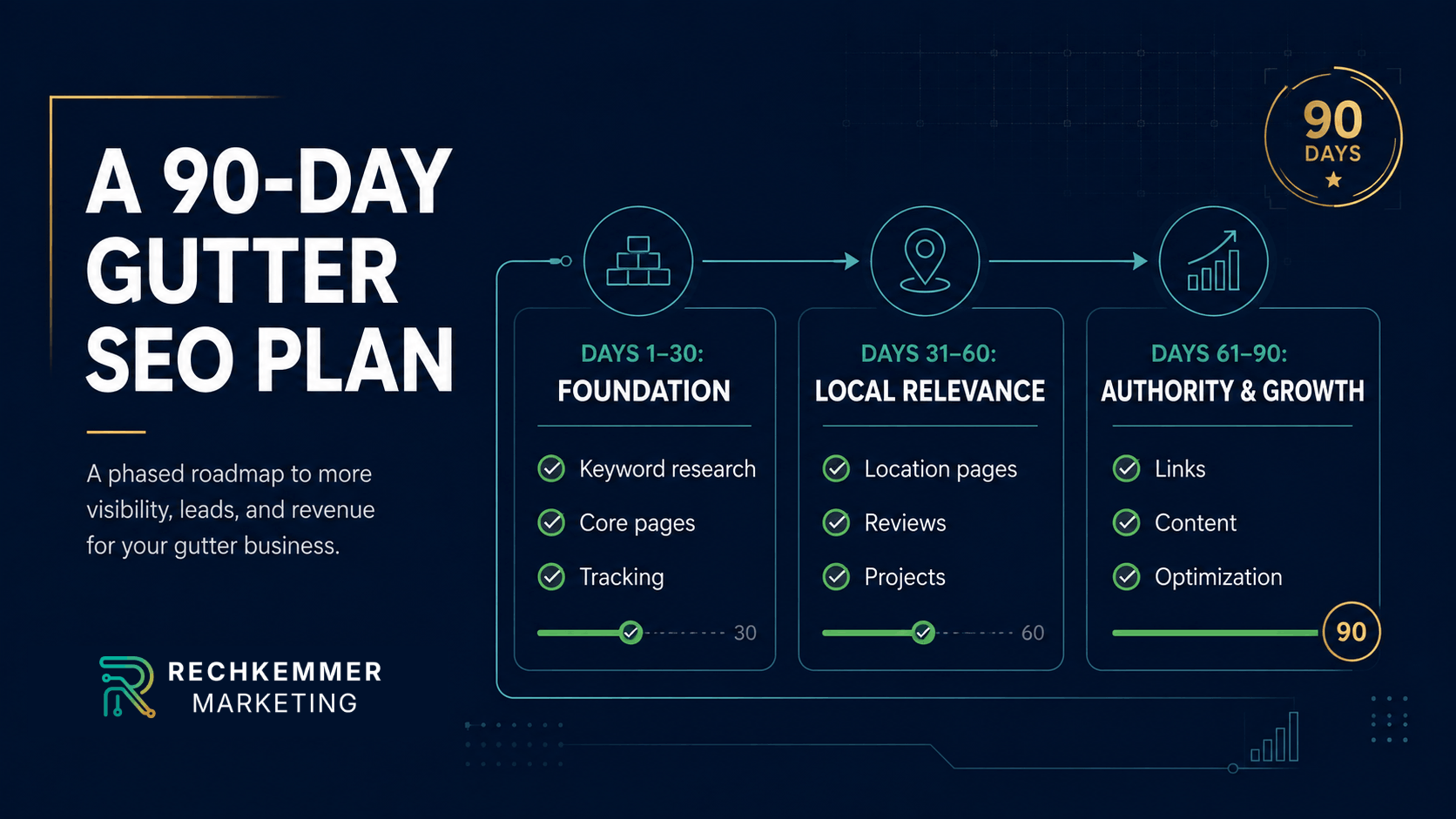
Ninety days is enough to build a serious foundation, even though meaningful SEO growth can continue far beyond it.
Days 1–30: Build the Foundation
Start by determining what the business should rank for.
Keyword research
Map:
- services
- products
- locations
- problems
- comparisons
- cost queries
Competitor research
Identify:
- missing service pages
- local competitors
- architecture gaps
- content gaps
- link opportunities
Technical audit
Check:
- crawlability
- indexation
- redirects
- mobile usability
- performance
- internal links
- analytics
Google Business Profile
Review:
- categories
- services
- business details
- service areas
- photos
- reviews
- website
Tracking
Set up:
- Search Console
- analytics
- conversions
- call tracking where appropriate
- rank tracking
Days 31–60: Build Commercial and Local Relevance
Create or improve the highest-priority pages first.
Typical priorities:
- Gutter Installation
- Seamless Gutters
- Gutter Repair
- Gutter Replacement
- Gutter Guards
- Gutter Cleaning, if offered
- Drainage / Downspouts
Then evaluate:
- material pages
- gutter sizes
- commercial services
- adjacent services
- priority city pages
Begin documenting projects rather than waiting until the website needs new photos.
Days 61–90: Build Authority and Supporting Content
Start publishing content that supports high-value services.
Examples:
- installation cost
- repair vs. replacement
- 5-inch vs. 6-inch gutters
- gutter guard comparisons
- local drainage issues
At the same time:
- pursue relevant association memberships
- research manufacturer directories
- build legitimate local relationships
- request customer reviews
- identify competitor backlink gaps
- improve internal links
- monitor rankings and conversions
Then use the results to determine the next 90 days.
Gutter Contractor SEO Checklist
A long SEO plan is only useful if you can tell what your gutter company should work on first.
We condensed the most important recommendations from this guide into a 2-page Gutter Contractor SEO Quick Audit. It gives you 30 checks across your website, Google Business Profile, local authority, content, technical SEO, and tracking, then turns the results into a simple score out of 30.

Use the audit to identify your weakest areas, choose your five highest-priority fixes, and turn them into a 90-day plan.
Download the Free Gutter SEO Quick Audit →
2-page PDF • 30 checks • Takes about 5 minutes
Frequently Asked Questions About Gutter SEO
Is SEO worth it for gutter companies?
It can be when enough people in the service area search online for the services the company sells and the resulting jobs justify the investment.
The useful measurement is not simply traffic.
Track:
organic visibility → leads → estimates → jobs → revenue
What are the best keywords for gutter contractors?
The highest-value keywords depend on the company's services and market, but common commercial clusters include:
- gutter contractor
- gutter company
- gutter installation
- seamless gutters
- gutter replacement
- gutter repair
- gutter cleaning
- gutter guards
- downspouts
- commercial gutters
Combine these with relevant local modifiers and validate them against actual search demand and SERPs.
How many service pages should a gutter website have?
There is no ideal number.
Our 36-site architecture study showed recurring demand for installation, seamless gutters, guards, drainage/downspouts, repair, replacement, and cleaning, with additional opportunities around materials, sizes, commercial work, and adjacent services.
Create enough pages to represent meaningfully different services and search intents without manufacturing thin pages.
Do gutter companies need location pages?
Most multi-city gutter companies should evaluate them.
Create pages for important markets where the company genuinely works and can provide useful local information or proof.
Do not publish dozens of nearly identical city pages simply to insert city keywords.
Does Google Business Profile matter for gutter contractors?
Yes. Local gutter searches frequently trigger Maps results, and Google says local visibility is based primarily on relevance, distance, and prominence/popularity.
Website SEO and Business Profile optimization should be treated as connected parts of the same local strategy.
Should gutter companies publish blog posts?
Publish content when it answers something potential customers actually search for or need to know.
Useful categories include:
- cost
- product comparisons
- gutter problems
- maintenance
- seasonal questions
- project case studies
Don't publish generic articles simply to hit a monthly quota.
How do gutter contractors get backlinks?
Start with real business relationships:
- industry associations
- manufacturers
- dealers
- suppliers
- builders organizations
- Chambers
- roofers
- local partnerships
- sponsorships
- media
- useful expert contributions
Competitor backlink intersection research can reveal sources repeatedly linking to strong businesses in your market.
How much does gutter SEO cost?
It depends on the existing website, competition, target locations, number of services, authority, content needs, technical condition, and how much work the company handles internally.
Evaluate cost against qualified leads and revenue rather than judging the campaign solely by the monthly fee.
How long does gutter SEO take?
There is no reliable universal number.
Technical fixes, indexing, impressions, ranking improvements, Maps visibility, leads, and revenue are separate milestones and may move at different speeds.
Build the foundation first, measure progress, and continue investing where the data shows commercial opportunity.
The Gutter SEO Strategy in One Sentence
Build the pages customers need, make it obvious where and how you work, prove that you are a real gutter contractor, earn legitimate local and industry authority, and measure success all the way through booked jobs and revenue.
That's gutter SEO.
Need Help Growing Your Gutter Company With SEO?
Rechkemmer Marketing provides digital marketing services for gutter companies that want to generate more qualified leads from Google.
We can help with:
- gutter contractor SEO strategy
- keyword research and page planning
- service and location page creation
- Google Business Profile optimization
- local SEO and citation building
- content strategy
- link building
- technical SEO
- conversion tracking and reporting
The goal is simple: build a search presence that helps your gutter company get found for the services and locations that matter most, then track that visibility through calls, estimates, and booked jobs.
Looking for an SEO agency that understands gutter contractor marketing?