
Local SEO for Cleaning Companies: How to Rank Locally and Get More Cleaning Leads
Local SEO helps a cleaning company become easier to find when nearby customers search for the services it actually provides. For a service-area business, that can mean appearing in Google Maps and the Local Pack, ranking with service and location pages in organic search, and giving prospects enough information to call, request a quote, book a cleaning, or start a commercial conversation.
The mistake is treating Local SEO as one tactic. A stronger system connects search intent → keywords → website architecture → service and location pages → Google Business Profile and Maps → business information and reviews → local authority → measurement and ongoing improvement.
What Is Local SEO for a Cleaning Company?
Local SEO is the process of making a cleaning business easier to discover, understand, and evaluate when people search for cleaning services in the areas the company serves.
For most cleaning companies, local visibility happens across two major search surfaces:
- Google Maps and the Local Pack, where Google Business Profile information plays a major role.
- Local organic search results, where service, city, and other website pages can appear for relevant searches.
These surfaces are related, but they do different jobs.
Local organic results vs. Google Maps / Local Pack
A customer searching for:
house cleaning in [city]
may take one of two paths:
Local cleaning search │ ├── Google Maps / Local Pack │ └── Google Business Profile │ ├── Compare reviews │ ├── Check business information │ ├── Call │ └── Visit website │ └── Local organic results └── Service or location page ├── Evaluate the service ├── Confirm service area ├── Review proof └── Request quote / book / inquireThe Maps path helps customers quickly compare locally relevant businesses. The organic path gives the company more room to explain the service, where it is available, what is included, why the company may be a good fit, and what the customer should do next.
A strong Local SEO strategy supports both.
Why service-area businesses need a local strategy
Cleaning companies often travel to homes, offices, rental properties, construction sites, or facilities instead of serving customers at a storefront.
Search engines and customers therefore need to understand:
- What the company cleans
- Which areas it serves
- Which services are available in those areas
- Whether the business fits the specific search
- Whether the company appears credible and established
That requires more than adding city names to a footer. The website, Google Business Profile, reviews, business listings, and other public information should reinforce the same basic picture of the company.
How Local SEO turns visibility into cleaning inquiries
The business outcome is not a ranking.
The practical path is:
Search → visibility → evaluation → inquiry → qualified lead → booked job or contract
A company can rank and still underperform if it attracts the wrong searches, sends customers to the wrong pages, communicates its service area poorly, or makes the next step difficult.
That is why Local SEO begins with search intent.
Understand How Local Customers Search for Cleaning Services
Instead of treating keyword research as a giant list of phrases, classify searches by:
buyer → cleaning need → location → stage of decision-making
That makes it easier to decide which page should serve the search and what action the visitor is likely to take.
Residential and maid-service search intent
Residential searches often describe a specific service need:
- house cleaning [city]
- maid service [city]
- recurring house cleaning [city]
- deep cleaning [city]
- move out cleaning [city]
A search such as:
deep cleaning [city]
suggests service evaluation.
A search such as:
how often should I deep clean my house
is informational.
The first belongs naturally with a service-oriented page. The second may be better handled by educational content that can later guide the reader toward a service.
Commercial and janitorial search intent
Commercial searches can involve different language and a different buying process:
- commercial cleaning company [city]
- janitorial services [city]
- office cleaning services [city]
- facility cleaning company [city]
The decision-maker may be a facility manager, property manager, office administrator, or business owner.
Their next step may be a walkthrough, proposal request, consultation, or pricing conversation rather than an immediate booking.
Commercial strategy should therefore not simply copy residential strategy and add the word “commercial.”
Specialty-cleaning search intent
Specialty services can create distinct search behavior.
For example:
post construction cleaning [city]
represents a different need from:
weekly maid service [city]
Even if one company offers both, forcing them onto one generic cleaning-services page can weaken the usefulness of that page for both audiences.
Ready-to-book vs. informational searches
“Ready-to-book” is useful shorthand, not a formal Google classification.
The important question is:
What is the searcher trying to accomplish, and what page should help them accomplish it?
| Buyer / context | Example query | Likely intent | Best destination | Likely next action |
|---|---|---|---|---|
| Residential recurring | house cleaning [city] | Service evaluation | House-cleaning page | Quote or booking |
| Residential one-time | move out cleaning [city] | Specific service evaluation | Move-out cleaning page | Quote |
| Commercial buyer | janitorial services [city] | B2B evaluation | Janitorial page | Walkthrough or proposal |
| Specialty customer | carpet cleaning [area] | Specialty-service evaluation | Carpet-cleaning page | Call or quote |
| Informational searcher | how often should I deep clean? | Research | Resource article | Learn, then explore service |
The searcher’s job should influence the page’s job.
Build a Cleaning-Company Local Keyword Strategy
A useful keyword strategy starts with the business, not the keyword tool.
The sequence is:
services → geography → search intent → keyword groups → target pages
Start with core cleaning services
List the services that matter commercially, such as:
- Recurring house cleaning
- Deep cleaning
- Move-in / move-out cleaning
- Commercial cleaning
- Janitorial services
- Carpet cleaning
- Window cleaning
- Post-construction cleaning
Then ask:
- Which services are priorities?
- Which have meaningfully different customers?
- Which use different sales processes?
- Which are available throughout the service area?
- Which deserve separate pages because the intent is distinct?
Do not create a page simply because a keyword exists. Create it because the business offers a meaningful service and the page serves a real customer need.
Add geographic modifiers
Once the service inventory is clear, layer in geography:
- [service] + [city]
- [service] + [area]
- [service] near [location]
- [service] company + [location]
But do not assume each variation requires its own URL.
For example:
- house cleaning Cedar Falls
- house cleaners Cedar Falls
- residential cleaning Cedar Falls
- maid service Cedar Falls
may represent closely related intent that one strong page can address.
Keyword grouping is usually more useful than one-keyword-one-page thinking.
Prioritize by business value
A keyword can be relevant without being important.
Prioritize based on factors such as:
- Strategic importance of the service
- Profitability
- Actual service availability
- Customer type
- Competitive opportunity
- Likelihood of producing a qualified inquiry
Map keyword groups to pages
The real output of keyword research should be a page map.
| Service | Location | Intent group | Query theme | Related variants | Target page | Priority |
|---|---|---|---|---|---|---|
| House cleaning | Primary city | Recurring residential | house cleaning [city] | maid service, house cleaners | Residential cleaning page | High |
| Deep cleaning | Main service area | One-time residential | deep cleaning [city] | one-time deep clean | Deep-cleaning page | High |
| Commercial cleaning | Commercial market | B2B recurring | commercial cleaning [city] | office cleaning | Commercial-cleaning page | High |
| Janitorial services | Commercial market | B2B contract | janitorial services [city] | facility cleaning | Janitorial page | High where offered |
| Move-out cleaning | Selected areas | One-time turnover | move out cleaning [city] | move-in cleaning | Move-out page | Medium |
| Education | Local audience | Informational | cleaning questions | service FAQs | Resource content | Supporting |
Several related phrases can intentionally map to one useful page.
That is where keyword strategy becomes website strategy.
Build the Right Website Architecture for Local Search
Once you know which searches matter, turn them into a website structure customers and search engines can understand.
Three page types create the most confusion:
- Service pages
- Service-area pages
- City / location pages
Service pages
A service page focuses primarily on what you do.
Examples:
- Recurring House Cleaning
- Deep Cleaning
- Move-Out Cleaning
- Commercial Cleaning
- Janitorial Services
Its job is to satisfy a specific service need and explain who the service is for, what it includes, where it is available, relevant proof, and the next step.
Service-area pages
A service-area page explains where the company provides service, often across a larger region or group of communities.
Its purpose should be useful to customers—not merely to hold a long list of city names.
City / location pages
A city page establishes the company’s relevance to a specific market.
For example:
House Cleaning Services in [City]
A dedicated city page is most useful when the city represents a meaningful market and the page can provide useful local context.
When not to create another local page
Suppose a cleaning company offers three services across eight cities.
Creating:
3 services × 8 cities = 24 pages
is not automatically a good strategy.
If those pages would be nearly identical except for swapped city names, a smaller structure may be stronger.
Homepage │ ├── House Cleaning ├── Deep Cleaning ├── Move-Out Cleaning ├── Commercial Cleaning │ ├── Service Areas │ ├── Priority City A │ ├── Priority City B │ └── Priority City C │ └── ResourcesCreate the smallest useful architecture that clearly represents your services and meaningful markets.
| Page type | Primary job | When justified | Common misuse |
|---|---|---|---|
| Service page | Explain a cleaning service | Service has distinct intent and business value | Combining unrelated services |
| Service-area page | Explain geographic coverage | Regional coverage needs clarification | Listing cities with no additional value |
| City page | Establish relevance to one market | City is strategically important and supports useful content | Mass-produced city-name swaps |
The Local SEO decision is which pages should exist, what intent each serves, and how they relate to one another.
Optimize Cleaning Service Pages for Local Search Intent
Once the architecture is clear, optimize each service page around one primary customer need.
Match the page to one service intent
A strong service page typically explains:
- The service
- Who needs it
- Common use cases
- What is included
- Service-area context
- Relevant proof
- Customer questions
- Next step
A deep-cleaning page should primarily help someone evaluating deep cleaning. A commercial office-cleaning page should serve the needs of a business buyer.
Use local context naturally
Local relevance is not the same as repeating a city name in every heading.
Useful geographic context can include:
- Areas served
- Service availability
- Relevant local proof
- Links to appropriate location pages
The language should still sound natural if keyword-tracking tools disappeared tomorrow.
Align page elements
The page title, H1, introduction, body copy, internal links, proof, and CTA should all reinforce the same service intent.
A compact service-page check:
- One clear service intent
- Accurate title and H1
- Customer-focused service explanation
- Natural local context
- Important questions answered
- Relevant proof
- Logical internal links
- Clear next step
Match the CTA to the service
A commercial cleaning page may lead toward a walkthrough or proposal request.
A residential cleaning page may lead toward a quote or booking inquiry.
The next step should reflect how the service is actually sold.
Create Useful City and Service-Area Pages Without Producing Thin Local Pages
Location pages are useful when they help customers evaluate service in a market.
They become weak when their main purpose is to create another URL containing another city name.
Decide which cities deserve dedicated pages
Consider:
- Is the city strategically important?
- Do you genuinely serve it?
- Is there meaningful demand?
- Can the page provide useful local information?
- Can the business maintain the page over time?
A city being within the driving radius does not automatically mean it needs a dedicated page.
Avoid city-name swaps
A thin approach looks like:
We provide professional cleaning in City A. Contact us for quality cleaning services in City A.
Then the same page appears for City B, City C, and City D.
A stronger page answers useful questions:
- Which services are available here?
- Which customers do you serve?
- Is recurring or commercial service available?
- What nearby areas are included?
- Is there relevant local proof?
- What should the customer do next?
The goal is not to invent artificial local differences. It is to justify the page with useful information.
Connect city and service pages
City pages and service pages should support one another.
City A Cleaning Services │ ├── Recurring House Cleaning ├── Deep Cleaning └── Move-Out CleaningThe city page explains the company’s presence in the market. The service pages explain the services in depth.
Use this decision framework:
| Question | If yes | If no |
|---|---|---|
| Is the market important? | Continue evaluating | Page may not be needed |
| Do you actually provide the service there? | Continue | Do not create it |
| Is there meaningful demand? | Continue | Consolidate |
| Can the page provide useful information? | Build or maintain | Use broader coverage page |
| Can you maintain it? | Include in architecture | Avoid unnecessary page |
Sometimes the right Local SEO decision is:
Do not create another page.
Use Google Business Profile and Maps as the Local Visibility Layer
The website is only one part of local search.
Google Business Profile gives cleaning companies another discovery and evaluation surface through Google Maps and local search results.
At a high level:
LOCAL SEARCH PRESENCE │ ├── WEBSITE │ ├── Service depth │ └── Location depth │ ├── GOOGLE BUSINESS PROFILE │ ├── Business identity │ ├── Services │ ├── Location / service-area context │ └── Reviews │ └── MAPS / LOCAL PACK └── Local discovery and comparisonThe website and profile should reinforce the same real business.
Keep services and geography clear
A cleaning company’s profile should accurately represent its business type, services, and location or service-area model.
The goal is clarity—not filling every field with every possible keyword variation.
Understand relevance, proximity, and prominence
Local visibility is often discussed through three broad concepts:
- Relevance: how closely the business fits the search
- Proximity: the relationship between the searcher and business location context
- Prominence: the broader visibility and reputation around the business
These are useful concepts, not a complete ranking formula.
A cleaning company can improve its information, website, reviews, and public presence. It cannot simply choose additional service areas and make physical geography irrelevant.
For a deeper walkthrough of profile setup and Maps-specific execution, see Google Business Profile Optimization for Cleaning Companies + Maps SEO.
Keep Your Business Information Consistent Across the Local Web
A cleaning company may appear on its website, Google Business Profile, business directories, review platforms, social profiles, community organizations, and other third-party websites.
The practical goal is not perfect character-for-character duplication.
It is to make sure important sources describe the same real business.
Establish canonical business information
Document the correct:
- Business name
- Primary phone
- Website
- Address where applicable
- Service-area information
- Core business details
Use that information as the reference point when reviewing other profiles.
Understand citations vs. backlinks
A citation is a public mention or listing of the business and its identifying information.
A backlink is a clickable link from another website.
They may overlap, but they are not the same thing.
Relevant listing sources vary by company. Local directories, industry listings, community organizations, and platforms such as Yelp or Angi may be worth evaluating depending on the market and customer base.
Do not treat every directory as mandatory.
Fix meaningful inconsistencies first
Prioritize problems such as:
- Old phone number
- Wrong website
- Incorrect business name
- Outdated location information
- Duplicate listings
- Services the business no longer provides
Minor punctuation differences are not equivalent to sending customers to an obsolete phone number.
A practical workflow is:
establish canonical information → audit important profiles → correct meaningful conflicts → add relevant missing sources → monitor
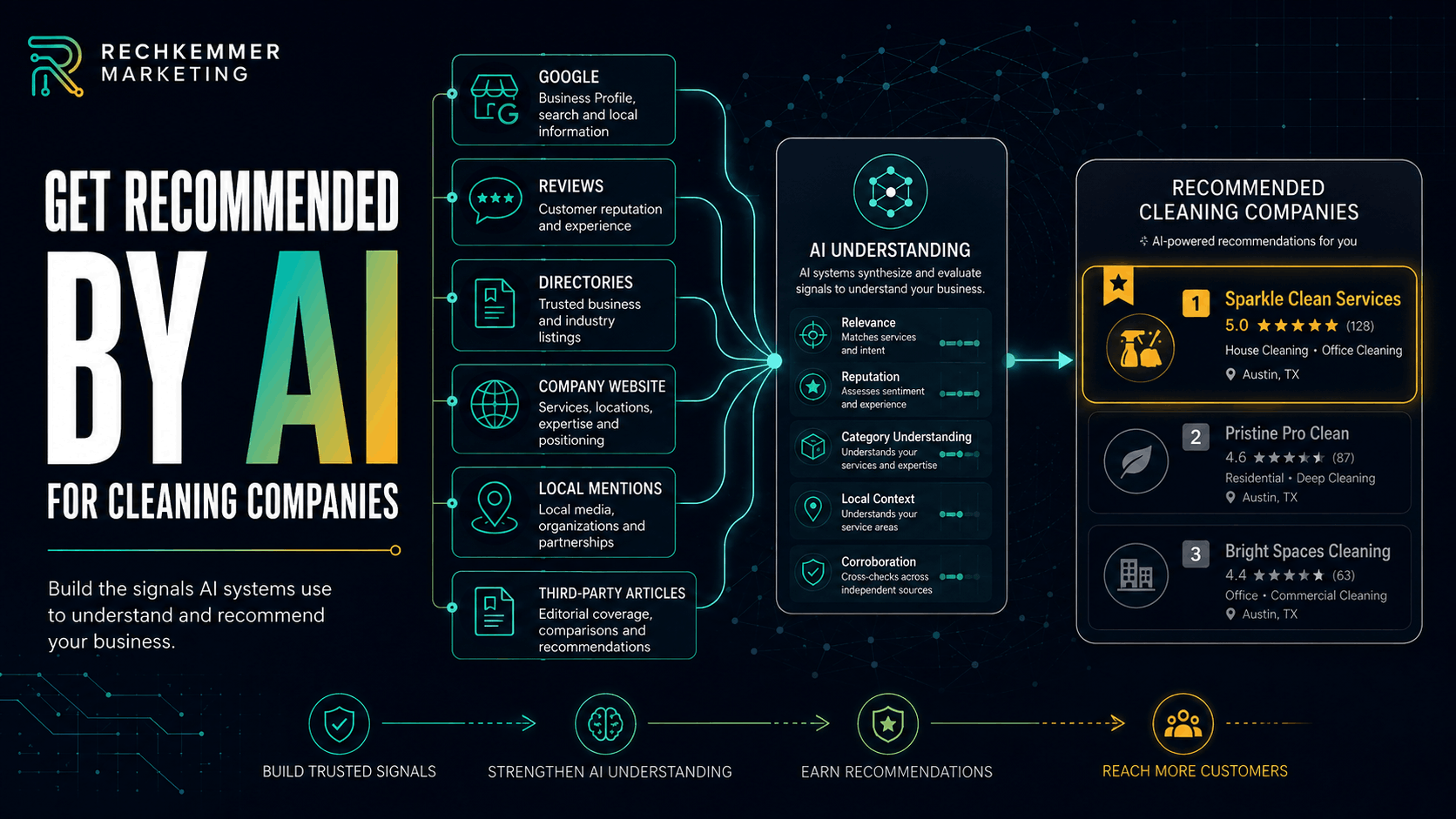
Keeping public business information clear can also matter to the broader question of how other systems understand a company. For that topic, see How Cleaning Companies Can Get Recommended by AI.
Build a Review System That Strengthens Local Trust
Reviews provide public customer evidence and should be treated as an ongoing operating process rather than an occasional campaign.
Ask at appropriate moments
A residential cleaner might request a review after:
- A successful first service
- A deep clean
- A positive customer interaction
- An established recurring relationship
Commercial relationships may require different timing.
The principle is simple: ask genuine customers consistently at appropriate points.
Respond and reuse proof
Respond professionally where appropriate, and avoid turning responses into keyword-heavy promotional copy.
Relevant reviews can also support:
- Service pages
- Location pages
- Homepage trust sections
- Commercial pages
Match the proof to the context where possible.
| Stage | Action |
|---|---|
| Trigger | Appropriate customer milestone |
| Request | Ask through a suitable channel |
| Follow-up | Keep reasonable |
| Response | Respond professionally |
| Reuse | Surface relevant proof |
| Monitor | Watch reputation themes |
There is no universal review count that guarantees local rankings.
Focus on genuine reviews and a customer experience worth reviewing.
Build Local Authority With Relevant Backlinks and Relationships
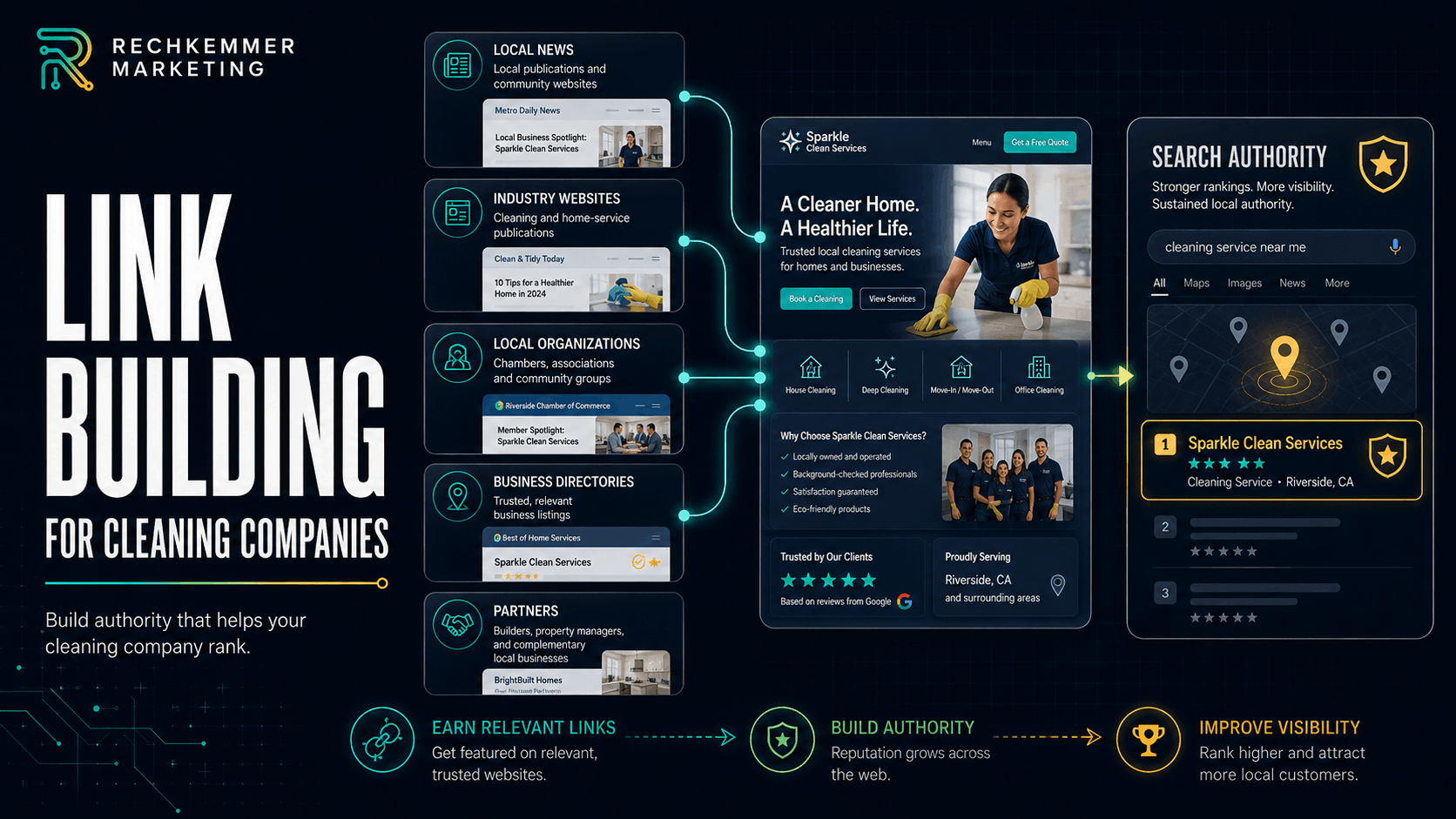
Relevant backlinks and third-party references can come from local organizations, complementary businesses, industry associations, suppliers, publications, and genuine partnerships.
The goal is not to accumulate random links. Look for relationships that make sense for the business and may also create referral exposure.
A commercial cleaning company may pursue different relationships from a residential maid service or specialty cleaner.
For prospecting, outreach, competitor gaps, reclamation, and monitoring, see Link Building for Cleaning Companies.
Publish Local Content That Supports Your Core Service Pages
Blogging is not a substitute for strong service pages.
Supporting content works best when it answers a real customer question and connects naturally to a relevant service.
Useful topics might include:
- What is included in a move-out cleaning?
- How often should an office be professionally cleaned?
- What is the difference between recurring and deep cleaning?
- What should a business expect during a janitorial walkthrough?
The structure is:
customer question → useful resource → relevant internal link → service page
The informational content serves the research need. The service page serves the buying need.
Before publishing, ask:
Would this resource still help a customer if search engines did not exist?
If not, reconsider whether the page needs to exist.
Strengthen the Website With Local SEO Technical Basics
A cleaning-company owner does not need to begin with an enterprise technical audit.
Focus on fundamentals that support accessibility and usability.
Cover the essentials
Important basics include:
- Mobile-friendly pages
- Reasonable load times
- Clear internal linking
- Crawlable core pages
- Optimized images
- Accurate structured data where appropriate
- Working forms and conversion paths
Structured data can help describe factual information about the business in a standardized format. It should reflect the real company and match visible website information.
It is structured clarification—not a ranking shortcut.
Before deploying markup, validate the implementation against the real site and current structured-data guidance.
Technical Local SEO checklist
- Site works well on mobile
- Important pages load reasonably
- Core pages can be accessed and crawled
- Internal links reflect the architecture
- Broken links and obvious errors are addressed
- Structured data is accurate where used
- Images are optimized
- Forms and inquiry paths function
Technical SEO should support the Local SEO system rather than become the entire strategy.
Expand Local Visibility Beyond Google Where It Makes Sense
Once the website, Google Business Profile, important business information, and review foundation are in place, consider additional local discovery environments such as Apple’s and Microsoft’s ecosystems.
Maintain accurate information where the effort is reasonable and relevant.
The priority is:
core foundation first → additional platform coverage second
Do not spread resources across every available platform before the main system is working.
Measure Local SEO by Leads, Not Rankings Alone
Rankings matter because they diagnose visibility.
They are not the business outcome.
A useful measurement ladder is:
visibility → action → inquiry → qualified lead → booked customer or contract
Track visibility
Monitor important keyword rankings and Maps visibility across the markets that matter.
Ranking data can help reveal:
- Weak services or locations
- Pages appearing for unintended searches
- Multiple pages competing for similar queries
- Geographic differences in Maps visibility
Track inquiries and lead quality
Depending on the business and tracking setup, useful metrics may include:
- Calls
- Forms
- Quote requests
- Booking starts
- Commercial inquiries
- Walkthrough requests
- Qualified leads
- Bookings or contracts where trackable
| Metric | Stage | Main question |
|---|---|---|
| Keyword ranking | Visibility | Are the right pages appearing? |
| Maps visibility | Visibility | Are priority markets improving? |
| Website/profile action | Engagement | Are searchers taking a next step? |
| Call/form/quote | Inquiry | Are we generating demand? |
| Qualified lead | Lead quality | Does the inquiry fit the business? |
| Booking/contract | Business result | Is Local SEO contributing to customers? |
Suppose rankings improve but quote requests remain flat.
Investigate whether the pages are appearing for the right searches, whether visitors are landing on the correct pages, whether the geography is appropriate, and whether the next step is clear.
The goal is not to prove that rankings increased.
It is to understand whether visibility is turning into qualified demand.
How Long Does Local SEO Take for a Cleaning Company?
There is no universal Local SEO timeline.
Progress depends on factors such as:
- Existing website quality
- Current Google Business Profile presence
- Service and location clarity
- Competition
- Reviews and reputation
- Business-information accuracy
- Existing third-party presence
- Consistency of ongoing work
Some improvements can be completed directly: fixing inaccurate information, improving page architecture, creating missing service pages, or strengthening internal links.
Changes in visibility, inquiries, and bookings may take longer and can vary by market.
Local SEO also requires maintenance. Services change, listings become outdated, reviews accumulate, competitors change, and measurement reveals new weak points.
Treat it as an ongoing business system rather than a project with a permanent finish date.
Common Local SEO Mistakes Cleaning Companies Should Avoid
| Mistake | Better approach |
|---|---|
| Targeting broad or irrelevant keywords | Prioritize service, geography, intent, and business value |
| Sending searches to the wrong page | Map query groups to clear page roles |
| Mass-producing city pages | Build only useful, justified local pages |
| Ignoring Google Business Profile | Maintain an accurate profile aligned with the website |
| Leaving conflicting business information | Correct meaningful inconsistencies |
| Neglecting reviews | Build an ongoing review process |
| Relying only on citations | Combine listings with reputation and relevant relationships |
| Ignoring relevant backlinks | Earn links through legitimate local and industry relationships |
| Poor mobile usability | Make key pages easy to use on a phone |
| Weak internal linking | Connect pages according to the site architecture |
| Focusing only on rankings | Track inquiries, qualified leads, and bookings |
| Treating Local SEO as one-time work | Maintain the system continuously |
| Targeting every nearby city | Prioritize real markets and useful coverage |
The correction usually begins with the earliest weak layer rather than adding another tactic on top of a broken foundation.
Frequently Asked Questions About Local SEO for Cleaning Companies
What is Local SEO for a cleaning company?
Local SEO helps a cleaning business become easier to find when nearby customers search for relevant services and creates a path from search visibility to inquiry.
How does Local SEO help a cleaning business get more customers?
It connects relevant search visibility with service pages, Maps results, reviews, calls, forms, and other conversion paths.
What keywords should cleaning companies target?
Start with commercially important services, then add meaningful geographic and intent variations. Separate residential, commercial, and specialty searches where the buyer need differs.
Can a cleaning company rank in multiple cities?
Yes, potentially. Focus on real service coverage, meaningful markets, useful page architecture, and local relevance rather than automatically creating a page for every city served.
What is the difference between a service page, service-area page, and city page?
A service page explains what you do. A service-area page explains broader geographic coverage. A city page establishes relevance to a specific market.
Does a cleaning company need a website for Local SEO?
A website provides depth around services, locations, proof, and next steps that a local profile alone cannot provide.
How important is Google Business Profile?
It is an important local discovery layer, especially for Maps and Local Pack visibility, but it is only one part of the broader system.
How many reviews does a cleaning company need?
There is no universal number that guarantees rankings. Build a consistent process for earning genuine reviews.
Do backlinks matter for Local SEO?
Relevant backlinks can provide useful third-party references and referral exposure. Relevance and legitimacy matter more than arbitrary volume.
Do cleaning companies need blog content?
Not necessarily first. Build strong service and local pages before expanding supporting content.
How long does Local SEO take?
It depends on the starting point, competition, market, website, profile, reputation, and consistency of the work.
Is Local SEO better than Google Ads?
They solve different problems. Local SEO builds organic and Maps visibility over time, while paid search offers more immediate control over paid exposure. Many businesses use both.
Build Your Cleaning Company Local SEO System Step by Step
Local SEO works best when you build it in dependency order.
Complete cleaning-company Local SEO checklist
1. Prioritize services
- Identify the services you want to grow
- Separate residential, commercial, and specialty offers where needed
2. Understand search intent
- Identify buyer and service need
- Separate service-evaluation from informational searches
3. Build the keyword map
- Add meaningful geographic modifiers
- Group close variants
- Assign important query groups to pages
4. Build the architecture
- Establish core service pages
- Define meaningful geographic coverage
- Create only justified city pages
5. Optimize core pages
- Match each page to one intent
- Add local context, proof, internal links, and a clear next step
6. Improve Google Business Profile
- Keep business identity, services, and location information accurate
- Align the profile with the website
7. Standardize business information
- Establish canonical data
- Audit important listings
- Correct meaningful conflicts
8. Build the review system
- Define request triggers
- Ask consistently
- Respond professionally
- Monitor themes
9. Strengthen local authority
- Build legitimate local and industry relationships
- Earn relevant backlinks over time
10. Publish supporting content
- Answer real customer questions
- Connect useful resources to relevant service pages
11. Cover technical basics
- Mobile usability
- Speed
- Internal links
- Crawlability
- Accurate structured data
- Images and forms
12. Expand platform coverage selectively
- Review other relevant local ecosystems after the core foundation is working
13. Measure the full funnel
- Rankings
- Maps visibility
- Calls and forms
- Qualified leads
- Bookings or contracts where trackable
14. Maintain the system
- Update services and locations
- Maintain important listings
- Continue review generation
- Monitor performance
- Improve the earliest weak layer
For an existing cleaning company, use the checklist as an audit rather than assuming everything needs to be rebuilt.
If the wrong pages target the wrong searches, fix that before creating more content. If visibility improves but qualified inquiries do not, investigate intent, geography, page fit, and the customer journey before chasing more rankings.
Local SEO works best when each layer reinforces the next: the right searches lead to the right pages, the business is represented clearly across the local web, customers can evaluate the company, and measurement shows whether that visibility is producing qualified cleaning demand.