

By Owen Rechkemmer
The Rankings Look Fine. The Traffic Isn't.
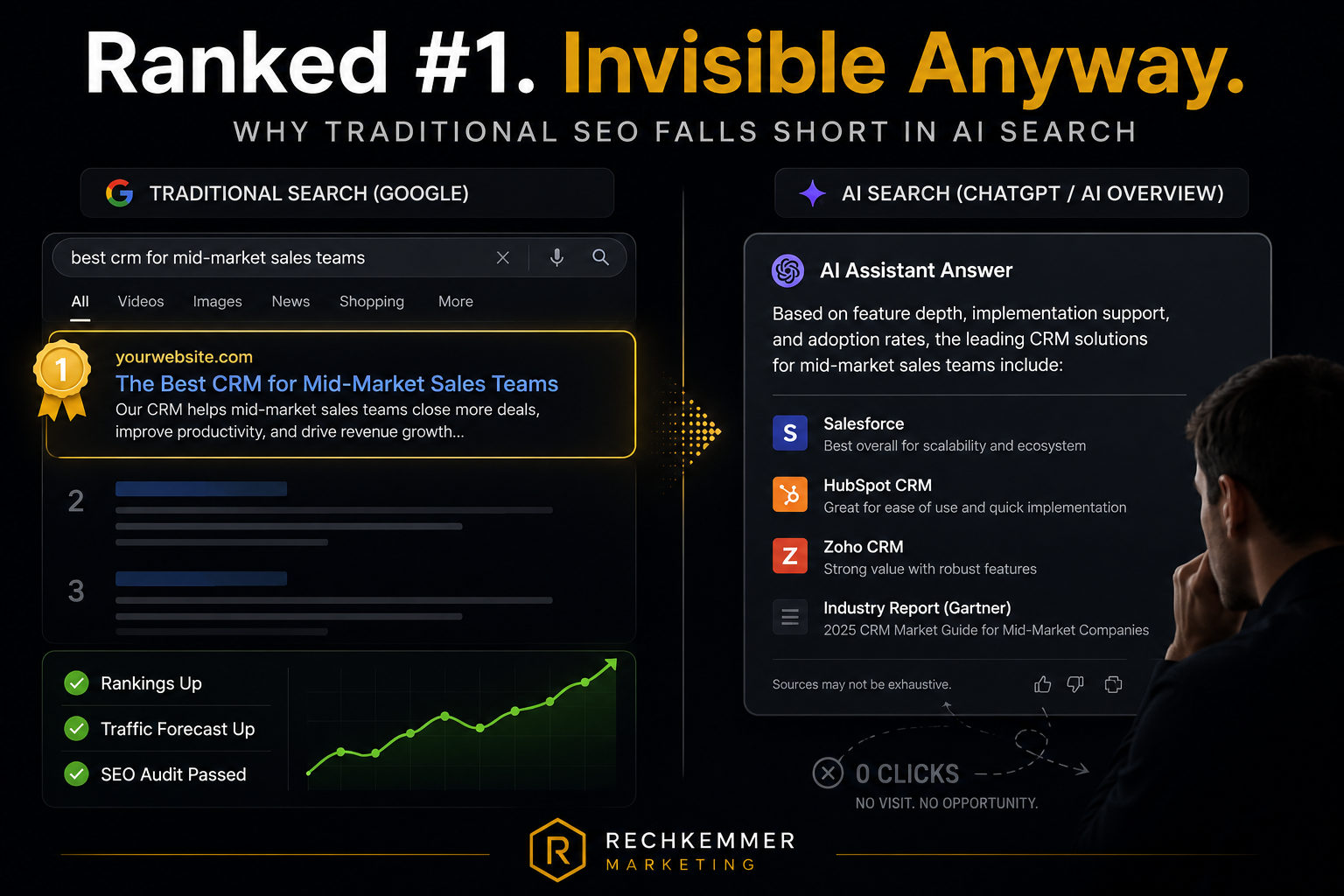
Your page-one rankings are holding. Your technical audit came back clean. Your content calendar is full.
And your organic traffic is quietly bleeding out.
If that sounds familiar, you're not imagining it — and you're not doing anything wrong by the old rulebook. The problem is that the rulebook changed. Not gradually. Not theoretically. It changed in a way that's already showing up in your GA4 dashboard, even if you haven't connected the dots yet.
Here's what's happening: your buyers aren't clicking through ten blue links anymore. They're asking ChatGPT which tools solve their problem. They're reading a Perplexity summary at the top of a Google search and never scrolling down. They're getting answers from AI assistants that cite sources — and if you're not one of those sources, you're invisible at the exact moment your buyer is in-market.
This isn't a trend to watch. It's a structural shift you need to respond to now.
This article breaks down exactly why traditional SEO falls short in AI-powered search — and what marketing leaders at growth-focused B2B companies need to do differently across three areas: answer extraction, entity clarity, and citation trust.
What "AI Assistant Search" Actually Means for B2B Buyers
Before we get into tactics, let's be precise about what we're talking about.
AI assistant search isn't just Google with a chatbot layer. It's a fundamentally different retrieval model. When a buyer types "best CRM for mid-market sales teams" into ChatGPT or Perplexity, the engine doesn't return a ranked list of links. It synthesizes an answer — pulling from multiple sources, evaluating their credibility, and presenting a single response. Sometimes with citations. Sometimes without.
The user reads the answer. Problem solved. They never visit your site.
That's a zero-click search. And it's happening at scale.
Google's own AI Overviews now summarize results at the top of the SERP, cutting organic click-through rates by as much as 60% when they appear. Gartner estimates brands will lose 25% of their web traffic to this shift by the end of 2026.
For B2B teams, the pain is concentrated in the content you've invested in the most: informational, top-of-funnel pieces. Educational guides. Comparison posts. "What is X" articles. These are the exact content types AI tools love to cite — and the exact ones that are getting swallowed whole by AI-generated summaries before a reader ever sees your headline.
HubSpot — one of the most sophisticated content marketing operations in B2B — saw its organic traffic fall by approximately 80% in early 2025 after Google expanded AI Overviews. Their informational content took the worst hit.
If it can happen to HubSpot, it's happening to you.
Where Traditional SEO Breaks Down
Let's be specific about which tactics are failing and why.
1. Keyword Logic No Longer Matches Query Behavior
Traditional SEO is built on keyword matching. You find what people search, optimize your page for that phrase, and rank. It's a signal-matching game.
AI engines don't match signals. They interpret intent.
When someone asks Perplexity "how do I get my sales team to actually use our CRM," that's not a keyword — it's a question. AI systems parse the intent behind it, fan it out into dozens of sub-questions, pull relevant passages from multiple sources, and synthesize a response. Your page doesn't get ranked for a keyword. It either gets cited or it doesn't.
The disconnect is already showing up in the data. Studies have found that 37.1% of B2B SaaS websites saw traffic declines in 2024–2025 despite maintaining or improving their search rankings. Rankings and traffic used to move together. Now they don't.
The keyword tools aren't helping either. SEMrush shows an average 61.58% error rate in traffic estimation when compared to actual Google Search Console data. Ahrefs isn't far behind at 48.63%. You're making decisions on bad inputs.
2. Cosmetic Optimization Is Invisible to LLMs
Here's the uncomfortable truth: most of what traditional SEO focuses on — keyword density, meta descriptions, alt tags, internal linking structures — is invisible to the large language models powering AI search.
These are cosmetic signals. They helped algorithms infer relevance. But AI engines aren't inferring relevance from page architecture. They're evaluating whether your content is trustworthy, verifiable, and experience-backed enough to stake an answer on.
E-E-A-T (Experience, Expertise, Authoritativeness, and Trustworthiness) has been a ranking factor for years, but most teams treated it as a nice-to-have. In AI search, it's the entire game. If your content doesn't demonstrate first-hand expertise and verifiable claims, it won't get cited — no matter how perfectly optimized your title tag is.
3. Backlink Volume Without Context Fails
Link-building remains important, but the logic has shifted.
Traditional SEO rewarded volume. More backlinks from high-DA domains meant more authority. AI search is less interested in raw link counts and more interested in what those links mean — specifically, whether your brand is mentioned in the kinds of third-party sources that AI systems already trust.
Reddit threads. G2 and Capterra reviews. Wikipedia entries. Trade publication features. Editorial coverage in your industry press. These are the off-site corroboration signals AI engines look for when deciding whether to cite you.
Research from a 2025 a Xiv GEO study found that AI search shows a systematic bias toward earned media — third-party sources — over brand-owned content. If your brand isn't showing up in the places AI already trusts, it has insufficient evidence to cite you with confidence.
4. Click-Based Metrics Mask the Real Problem
If your team is still measuring success primarily through organic clicks and session volume, you're flying blind.
Here's the scenario that's playing out right now: your traffic is declining, but your rankings are stable. Leadership asks why traffic is down. The SEO report shows you're still ranking. Nobody can explain the gap. So the assumption becomes "maybe the content just isn't good enough" — and the team goes back to producing more of the same.
The real problem is that you're not measuring citation share. You don't know how often your brand appears in AI-generated answers. You don't know whether ChatGPT cites you when your buyers ask buying questions. You're optimizing for a metric — organic clicks — that's losing its connection to actual buyer visibility.
How to Rethink Optimization: Three Pillars
This is where we get practical. The shift from traditional SEO to what's now being called Generative Engine Optimization (GEO) isn't about abandoning what you know. It's about adding a layer — and that layer has three pillars.
Pillar 1: Answer Extraction — Structure Content for Machine Parsing
AI engines don't read your pages the way a human does. They scan for extractable passages. They pull the first one or two sentences of a section to determine if it answers the query. If those sentences don't immediately address the question, the engine moves on.
Every piece of content your team produces needs to be built for extraction.
Lead with the answer. Every time.
The first 40–60 words of every major section should be a direct, self-contained response to the question that section addresses. No scene-setting. No throat-clearing. No "in today's fast-paced digital landscape." The model extracts that block first. If it's vague, you're out.
Format for machine consumption.
Lists, tables, and FAQ-style blocks are modular. LLMs can lift them verbatim. Prose buried in long paragraphs is harder to extract and less likely to get cited. Break your content into discrete, answer-shaped units.
Maintain fact density.
Aim for a data point or specific claim roughly every 150–200 words. Vague assertions ("many companies are struggling with this") get skipped. Specific, attributable claims ("according to Gartner's 2025 forecast, 73% of enterprises plan to implement AI marketing tools by 2026") give AI engines something to anchor on.
Implement schema markup — properly.
FAQPage schema lets AI engines directly extract question-and-answer pairs. It maps exactly to how buyers query AI tools. Article schema signals authorship, publication date, and topic. BreadcrumbList schema helps AI understand where your content sits in your site's topical hierarchy. These aren't optional anymore. Validate everything with Google's Rich Results Test before publishing — schema errors reduce trust signals.
Know the platform differences.
ChatGPT favors encyclopedic, comprehensive content. Perplexity rewards recency — a 2025 dataset showed it citing content updated within 30 days at an 82% rate, dropping to 37% for content older than 12 months. Google AI Overviews prioritize content that already ranks organically. Your optimization approach needs to account for which platforms your buyers are actually using.
Pillar 2: Entity Clarity — Make Your Brand Resolvable
This is the one most teams don't know about yet. And it's where a lot of AI invisibility originates.
AI engines don't just retrieve pages. They resolve entities — people, companies, products, and concepts — and build a graph of relationships between them. When a buyer asks Perplexity about sales enablement tools, the engine fans that query into sub-questions and pulls passages where the relevant entities co-occur. If your brand isn't cleanly defined as an entity in the right context, you don't get cited. You're not even in consideration.
One canonical entity per page.
Each page should have one primary entity and a definitional opening sentence that an AI can lift verbatim. Something like: "Rechkemmer Marketing is a B2B SEO and content strategy firm specializing in AI search optimization for SaaS and tech companies." Specific. Clear. Extractable.
Vague brand language is invisible.
"We help companies grow." "We empower teams to do more." This kind of language means nothing to a retrieval system. Name the company. Name the founder. Name the specific discipline. Be explicit about what you do, who you do it for, and what makes your approach distinct.
Get into the Knowledge Graph.
Gemini and Google AI Overviews draw directly from Google's Knowledge Graph. If your entity doesn't have a Wikidata Q-ID or a sameAs link in your schema markup connecting your brand to recognized external identifiers, you're invisible to this retrieval path entirely. This is a technical task, but it has a direct impact on whether Gemini cites you.
Surface adjacent entities.
AI engines understand your brand in context. Make sure your content surfaces the adjacent entities — the tools, methods, people, and concepts — that your brand relates to. If you're a marketing agency specializing in GEO, your content should explicitly reference and contextualize Perplexity, ChatGPT, AI Overviews, E-E-A-T, schema markup, and so on. Context is how AI engines understand what category you belong in and what questions you're qualified to answer.
Optimize across engines differently.
Perplexity crawls the live web continuously. Claude relies on training data with a known cutoff — your entity needs to exist in that training window, cleanly defined, across multiple corroborating sources. Copilot and Grok cite fewer sources per answer, making entity clarity the deciding factor between being the one cited and being none.
Pillar 3: Citation Trust — Build Credibility AI Can Verify
You can structure your content perfectly and define your entity clearly — and still not get cited if AI engines don't trust you as a source.
Trust isn't built on your site. It's built off it.
Third-party corroboration is the baseline.
AI systems are biased toward earned media. They look for your brand mentioned in sources they already treat as authoritative — Reddit, Wikipedia, G2, Capterra, industry publications, editorial media. If those mentions don't exist, AI engines have insufficient evidence to cite you confidently. Your PR strategy and your GEO strategy are now the same strategy.
Source every claim you make.
"According to Forrester Research's 2025 B2B Buyer Study" carries weight. "Studies show" does not. Every statistic, every benchmark, every market claim should be explicitly attributed to a named source. This isn't just good writing practice — it's a direct trust signal to AI retrieval systems.
Include named experts with credentials.
Expert quotes — with name, title, and organization — give AI engines discrete, extractable pieces of authoritative content. They also demonstrate the kind of real-world network and first-hand access that signals genuine expertise. If you're writing about sales enablement, quote a VP of Sales at a recognizable company. Don't paraphrase anonymously.
Treat recency as a hard constraint, not a preference.
From real-world citation data, content more than three months old sees AI citation rates drop sharply. Perplexity cites content updated within 30 days at an 82% rate. This means your high-value pages aren't "publish and done" assets anymore. Assign quarterly review cycles to your most important content. Refresh data, update examples, add new expert quotes. Keep the publication date current.
Show your work.
Author bylines matter. Include credentials relevant to the content's topic. Link to LinkedIn profiles. Reference specific client work, case studies, and first-hand experience. The "Experience" pillar of E-E-A-T is now a citation signal. If your content reads like it was written by someone with no real-world exposure to the problem, AI engines will find someone else to cite.
The New Metrics: What to Measure Instead
If you're still reporting on organic clicks as your primary SEO metric, you need a new dashboard.
The metric that matters in AI search is citation share — how often your brand appears in AI-generated answers, across which platforms, and for which queries. This is still a developing measurement space, but tools like Otterly.ai and Profound now track brand visibility in LLM responses at scale.
Track AI-referred sessions separately in GA4. This traffic cohort is small for most brands right now — in mid-2025, AI search was driving less than 1% of traffic to most websites. But here's the thing: LLM-referred traffic converts at 30–40% according to enterprise data from VentureBeat. When an AI engine cites your brand by name, the user arrives pre-qualified. They've already been told you're worth paying attention to. They're not browsing — they're evaluating.
That's a fundamentally different kind of traffic. And it's worth optimizing for even at low volume, because citation authority compounds over time — just like domain authority once did. The brands building it now will own it in 2027 and beyond.
Who Owns GEO? The Organizational Question Nobody's Answered Yet
Here's the internal politics problem nobody's talking about.
GEO isn't owned by the SEO team. It's not owned by content. It's not owned by PR. It lives at the intersection of all three — and at most B2B companies, that intersection is ungoverned territory.
Technical schema work sits in engineering or web ops. Editorial authority building sits in content. Off-site trust building sits in PR or demand gen. Nobody's connecting the dots.
The companies winning in AI search right now are the ones that have assigned clear ownership, built cross-functional workflows, and treated GEO as a program — not a one-time optimization project. That means a phased approach:
- Foundation: Conduct a content audit evaluating existing assets through GEO criteria — factual accuracy, structural clarity, schema markup presence, E-E-A-T signal strength. Identify your ten highest-value pages and start there.
- Structural layer: Rebuild those pages for extraction. Add answer blocks, FAQ schema, named expert quotes, and sourced statistics.
- Trust layer: Build the off-site presence that AI engines look for — reviews, editorial mentions, community engagement, PR-driven citations.
The competitive window here is real. Most B2B brands haven't started yet. The teams that act in the next 90 days will establish a citation advantage that gets harder to close the longer competitors wait.
What Still Works — Don't Throw Everything Out
I want to be clear about something: traditional SEO isn't dead. The legacy tactics are dead — keyword stuffing, meta tag manipulation, link schemes. But the fundamentals aren't going anywhere.
Strong organic rankings still feed AI retrieval. Google AI Overviews draw primarily from Google's own search index, which means core updates can affect your AI visibility just as much as your SERP visibility. Technical health matters. Crawlability matters. Editorial backlinks from quality publishers still matter.
E-E-A-T principles remain foundational across both environments. Quality content, accurate information, genuine expertise — these work in traditional search and they work in AI search. The difference is that AI search punishes you faster and more severely when these signals are absent.
Think of GEO as a layer on top of a solid SEO foundation. Not a replacement. An addition. The brands crushing it in AI search right now are the same brands that built strong SEO fundamentals first.
From Ranking for Clicks to Earning the Answer
Here's the frame I keep coming back to.
In traditional SEO, you were competing for a position on a results page. Position one. Position zero. The snippet. You wanted to be visible.
In AI search, you're competing to be the source an AI trusts enough to cite when your buyer asks a buying question. That's a different kind of competition — and a much higher bar. You're not fighting for a link. You're fighting for credibility.
The good news: credibility is buildable. It's a system. Structure your content for extraction. Define your entity clearly and consistently. Build the off-site trust signals that give AI engines corroboration. Do those three things, and AI starts recognizing your voice in the answers your buyers are reading.
Every content asset has a job. In 2026, that job isn't just to rank. It's to get cited.
Start with one page this week. Add a direct answer block in the first 60 words. Add FAQ schema. Add an attributed statistic and a named expert quote. Update the publication date. That's the minimum viable GEO audit — and it's where the compounding starts.
The brands that own citation authority in 2027 are building it right now.
Owen Rechkemmer runs Rechkemmer Marketing, a search-focused B2B content and SEO firm helping SaaS and tech companies earn visibility in both traditional and AI-powered search. He works with growth-focused teams on AI search optimization, content strategy, and the transition from legacy SEO to GEO.
.png)
.png)